
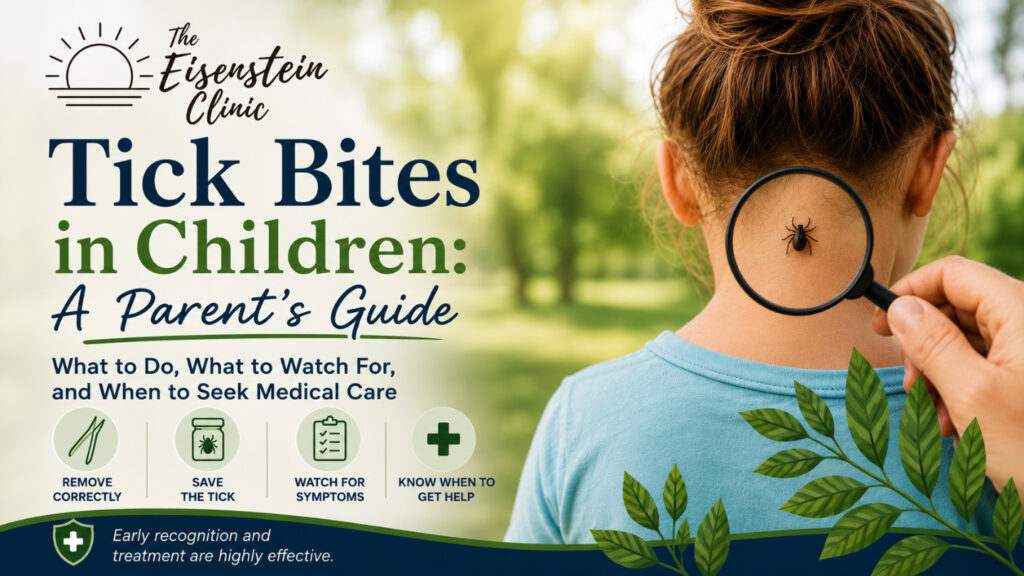
Use fine-tipped tweezers to remove the tick:
Parents may submit photos of ticks for identification through the University of Illinois Medical Entomology Laboratory.
Tick identification can help determine the species, but testing the tick does not always predict whether a person will become sick. Medical decisions should be based on your child’s symptoms, the length of time the tick was attached, and other risk factors.
It is common for children to experience a mild reaction at the site of a tick bite. These symptoms usually improve within a few days and are not typically a cause for concern.
Common reactions include:
If the redness continues to expand, becomes increasingly painful, or is accompanied by fever or other symptoms, contact your pediatric provider.
Although most tick bites do not result in illness, parents should monitor their child for symptoms that may indicate a tick-borne disease.
Contact your pediatric healthcare provider if your child develops:
Seek immediate medical attention if your child develops any of the following symptoms after a tick bite:
These symptoms require prompt evaluation and should not wait for a routine appointment.
Schedule an appointment with your pediatric provider if:
Your provider will determine whether testing or treatment is necessary. Preventive antibiotics are recommended only in certain high-risk situations and are not needed for most tick bites.
Reducing your child’s exposure to ticks is the best way to prevent tick-borne illnesses.
To help protect your child:
Most tick bites do not cause illness. However, some ticks can transmit diseases such as Lyme disease. Monitor your child for symptoms during the 30 days following a tick bite and contact your pediatric provider if symptoms develop.
A Lyme disease rash often begins as a small red area that gradually expands over several days. It may develop a bull’s-eye appearance, although not every child experiences this classic pattern. Any expanding rash after a tick bite should be evaluated by a healthcare provider.
Yes. Saving the tick may help identify the species if your child becomes ill. Place it in a sealed container with the date and location of the bite.
No. Most children do not need antibiotics after a tick bite. Your pediatric provider will determine whether preventive treatment is appropriate based on the type of tick, how long it was attached, and your child’s symptoms.
While the risk increases the longer a tick remains attached, not every tick carries Lyme disease. Removing ticks promptly is one of the best ways to reduce the risk of infection.
You should contact your pediatric provider if your child develops fever, an expanding rash, persistent headache, unusual fatigue, muscle aches, joint pain, facial drooping, weakness, numbness, or other concerning symptoms after a tick bite.
Early recognition and treatment of tick-borne illnesses are highly effective. If you have questions or concerns after your child experiences a tick bite, contact The Eisenstein Clinic for guidance and evaluation.